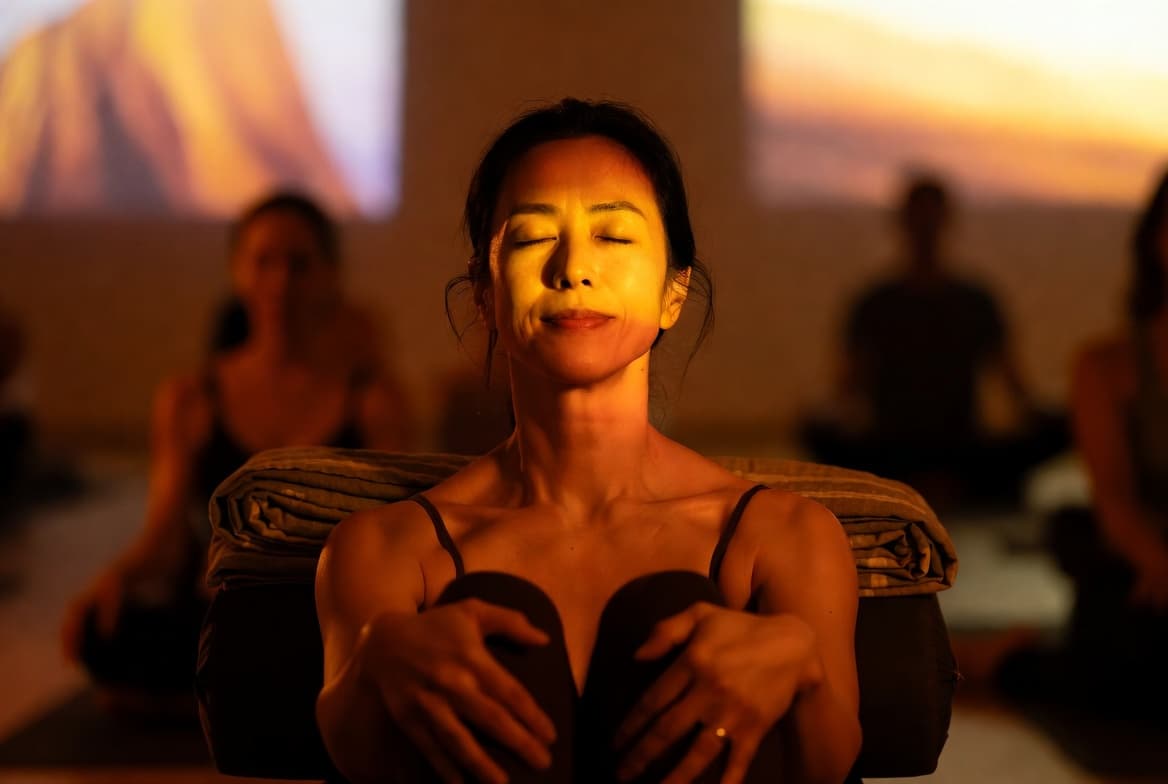
Yin yoga doesn't look like it does much. You sit or lie on the floor, fold into a shape, and stay there for five minutes. You don't sweat. Your heart rate barely changes. If you've come from a vinyasa or HIIT background, the first class can feel almost anticlimactic.
Then the benefits start showing up. Usually quietly. A week in, your hips feel different. Two weeks in, you sleep better. A month in, you notice you're less reactive during stressful meetings. Three months in, tightness you'd been carrying for years has meaningfully changed.
This is yin's character: low-drama during the class, meaningful outside it. Here's what's actually happening and why the benefits stack up the way they do.
Connective Tissue and Fascia Health
This is yin's primary claim and the benefit most practitioners notice first, because connective tissue is where most accumulated tightness lives.
Muscles respond to active stretching. They're made for it. But fascia — the sheets of connective tissue that wrap muscles, bundle organs, and connect everything in the body — responds differently. Fascia is slower. It doesn't care about a thirty-second stretch. It responds to sustained, gentle load held long enough that its visco-elastic nature starts to yield.
Yin's three-to-five-minute holds are designed exactly for this. The load is mild (you're not at your deepest possible expression, you're at the working edge). The time is long (enough for the tissue to shift rather than resist). The muscles stay soft (so the load actually reaches the fascia instead of getting absorbed by muscular bracing).
The practical effect: hips that felt permanently tight open up. Lower backs that ached from sitting start to feel different. Shoulder tension that didn't respond to stretching starts to release. These are connective-tissue adaptations, and yin is the most efficient practice for producing them.
Stress Reduction and Parasympathetic Activation
The human nervous system has two main modes:
- Sympathetic — the "go" mode. Alert, active, engaged. Fight-or-flight in its extreme form.
- Parasympathetic — the "rest and digest" mode. Calm, recovery-focused, regenerative.
Modern life keeps most people locked in sympathetic mode too much of the time. Emails, notifications, deadlines, traffic, caffeine — all of it tilts the nervous system toward alert even when nothing urgent is happening. Chronic sympathetic activation correlates with poor sleep, elevated cortisol, anxiety, digestive problems, and cardiovascular wear.
Yin practice directly activates the parasympathetic side. The long holds, slow breath, and lack of muscular effort cue the nervous system that the environment is safe and the body can downshift. Over the course of a class, heart rate variability improves. Cortisol drops. Breath lengthens. After class, that shift lingers — you feel noticeably calmer for hours.
Regular yin practice (1–3 classes per week) builds baseline parasympathetic tone. You don't just get the calming effect during class; you become more capable of finding that state during the rest of your week.
Improved Flexibility That Lasts
Flexibility gains from active stretching tend to be muscle-level — you extend a muscle's range, the muscle adapts over days, then regresses within days of stopping the practice. This is why athletes who stretch daily stay flexible and athletes who stop stretching for a week notice tightness return fast.
Yin's flexibility gains come from a different layer. The connective-tissue adaptations accumulate more slowly but also regress more slowly. Once you've spent three months improving hip-capsule range through yin, that range tends to hold even if you take two weeks off. The tissue has remodeled, not just temporarily elongated.
Practical implication: yin is the better flexibility investment for long-term mobility, while active stretching is the better choice for acute, short-term flexibility needs.
Joint Mobility and Range of Motion
Adjacent to flexibility but distinct from it — joint mobility refers to how freely a joint can move through its full healthy range. Connective tissue in and around the joint capsule determines much of this.
Yin targets joint capsules directly. Hip-focused yin sequences work the hip joint. Spine-focused sequences work the vertebral joints. Shoulder work targets the shoulder capsule. The long, sustained load at the edge of the joint's range stimulates remodeling in the capsule tissue.
For athletes, this matters because joint mobility protects against injury and supports athletic performance. For older practitioners, joint mobility is tied to independence — how easily you can sit down, stand up, reach, turn, and generally move through daily life.
Mental Stillness and Meditation Training
Yin is the only yoga style where the mental demand exceeds the physical demand. You can't distract yourself with movement, breathing patterns, or sequence complexity. You're just there, with your body in a shape, for a long time.
This makes yin an effective meditation-adjacent practice. The skills it trains — noticing sensation without immediately reacting, breathing through discomfort, staying with a single focus for minutes at a time — are the same skills formal meditation trains. For people who've tried seated meditation and found it frustrating, yin can be the back door in.
The mental benefits compound. Practitioners report:
- Reduced reactivity to daily stressors
- Better sleep quality and faster sleep onset
- Improved ability to concentrate for long stretches
- Less rumination on anxious thoughts
- A sense of being more "at home" in the body
These aren't placebo effects. The long holds literally train the nervous system to meet discomfort with steadiness. That capacity carries into every context where life presents something hard to sit with.
Complement to High-Intensity Training
Most active people eventually hit the recovery bottleneck. You can push harder in your strength training, run faster intervals, take more hot yoga classes — but without matched recovery, performance plateaus and injury risk climbs.
Yin fills the recovery gap in a way that most alternatives don't. Sleep helps but passive sleep doesn't address connective-tissue tightness. Foam rolling helps but reaches a fraction of what sustained yin holds do. Massage helps but is expensive and sporadic.
A once-a-week yin practice — especially in the 24–48 hours after intense training — supports recovery in measurable ways: shorter delayed-onset muscle soreness, faster range-of-motion restoration, improved sleep quality during recovery windows. ALIVE members who combine hard training (Particle barre, Wave power flow, Universe HIIT) with a weekly yin-style class (Aura) report consistently that the slow work is what lets them keep pushing in the other classes.
Better Sleep
Sleep research has grown an entire subfield around slow, passive evening practices and their effect on sleep architecture. Yin fits this category almost perfectly.
The mechanism: yin practice activates the parasympathetic nervous system, lowers cortisol, and downshifts heart rate variability toward recovery mode. Done in the evening — particularly 2 to 4 hours before bed — the effect primes the body for deeper sleep onset and more restorative sleep cycles.
This isn't universal — some people practice yin in the morning and find it activates them for the day. But for practitioners who struggle with sleep, evening yin is one of the most consistently recommended interventions in the yoga therapy literature.
Heated Yin: Why ALIVE Amplifies These Benefits
Every benefit above is magnified when yin is practiced in a warm environment. At ALIVE's Aura (92°F), the warmth does three specific things:
Muscles soften faster, so the fascia actually gets worked. In a cool room, you spend the first minute or two of a five-minute hold waiting for the muscle to release. In a warm room, that release happens quickly, and the full hold reaches connective tissue.
Fascia becomes more plastic. Warm fascia yields more to sustained load than cool fascia. The same pose, same hold time, reaches deeper.
Parasympathetic activation accelerates. Moderate warmth is itself mildly parasympathetic. Combined with yin's slow pace, the calming effect arrives faster and goes deeper.
For the full picture, see Heated Yin Yoga: Why It Works.
What the Benefits Look Like Over Time
Week 1. You notice you feel slightly loose afterward. Maybe sleep a little better that night. The class itself felt weird — long, quiet, mentally challenging in an unexpected way.
Week 3. Your hips or lower back feel different in a way that lasts past class day. You're starting to enjoy the stillness instead of enduring it.
Month 2. Flexibility gains are visible. You can fold further, sit more comfortably, move through ranges you couldn't access before. Your sleep has probably improved. Stress feels slightly less sharp.
Month 6. The benefits have stacked. You move differently. Your training recovery is better. You're less reactive under pressure. The practice feels less like exercise and more like maintenance for being a functional human.
Year 1. Yin is part of your life. You wouldn't stop because you can feel the difference when you do. The benefits aren't dramatic — they're foundational.
Yin at ALIVE Studios
ALIVE offers Aura at Plano, Southlake, and Las Colinas.
Neutron (Yin Yoga) — 85°F / 50%. The full yin practice. Long holds targeting connective tissue and fascia. Not on the schedule right now.
Aura (Yoga Calm) — 92°F / 50%. Yin-adjacent flow. Gentler movement, longer holds than flow classes, deep parasympathetic effect. Many members experience Aura as the most restorative class on the schedule.
Classes every 30 minutes. Morning, midday, evening — whenever fits your training rhythm.
Your first month is $24.99 unlimited. Take a few yin classes, pair them with active classes, and feel how the combination affects your training and recovery: start your trial month.